
Gumboots by DAVID BRUCE
Description
"The second it ended, their listeners leaped to their feet, screaming and shouting, like they'd been blown out of aircraft ejection seats."
Charleston City Paper
"an engaging new work which deserves a place in the chamber repertory"
Gramaphone Magazine
Charleston City Paper
"an engaging new work which deserves a place in the chamber repertory"
Gramaphone Magazine
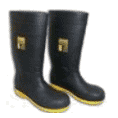 There is a paradox in music, and indeed all art - the fact that life-enriching art has been produced, even inspired by conditions of tragedy, brutality and oppression, a famous example being Messiaen's Quartet for the End of Time, written while he was in a prisoner of war camp. Gumboot Dancing bears this trait - it was born out of the brutal labour conditions in South Africa under Apartheid, in which black miners where chained together and wore Gumboots (wellington boots) while they worked in the flooded gold mines, because it was cheaper for the owners to supply the boots than to drain the floodwater from the mine. Apparently slapping the boots and chains was used by the workers as a form of communication which was otherwise banned in the mine, and this later developed into a form of dance. If the examples of Gumboot Dancing available online are anything to go by, it is characterised by a huge vitality and zest for life. So this for me is a striking example of how something beautiful and life-enhancing can come out of something far more negative. Of course this paradox has a far simpler explanation - the resilience of the human spirit.
My 'Gumboots' is in two parts of roughly equal length, the first is tender and slow moving, at times 'yearning'; at times seemingly expressing a kind of tranquility and inner peace. The second is a complete contrast, consisting of five, ever-more-lively 'gumboot dances', often joyful and always vital.
However, although there are some African music influences in the music, I don't see the piece as being specifically 'about' the Gumboot dancers, if anything it could be seen as an abstract celebration of the rejuvinating power of dance, moving as it does from introspection through to celebration. I would like to think however, that the emotional journey of the piece, and specifically the complete contrast between the two halves will force the listener to conjecture some kind of external 'meaning' to the music - the tenderness of the first half should 'haunt' us as we enjoy the bustle of the second; that bustle itself should force us to question or revaluate the tranquility of the first half. But to impose a meaning beyond that would be stepping on dangerous ground - the fact is you will choose your own meaning, and hear your own story, whether I want you to or not.
David Bruce, St Albans, Sept 2008
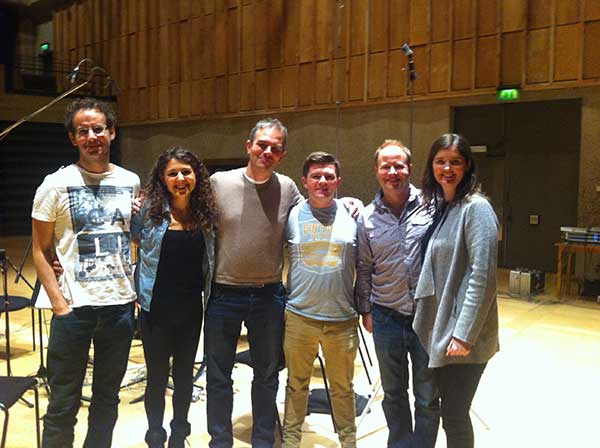
With the Julian Bliss and the Carducci String Quartet at the recording of Gumboots for Signum.
Press / Latest Reviews
|
yorkpress.co.uk / Jul 2019 Martin Dreyer
Bliss and the Carduccis raised the roof with David Bruce’s Gumboots (2008), which refers to South African labourers’ footwear in flooded gold mines. Its innocent opening, with bass clarinet, is deceptively calm. What follows, with normal clarinet, is a whacky dance that grows increasingly wild, with jazzy syncopation, crazy cross-rhythms, trills and eventually all three together. The enjoyment of all five of these brilliant players was irresistibly infectious. |
|
limelightmagazine.com / Nov 2018 Angus McPherson
Between the two string quintets, clarinettist Georgina Oakes joined Chen, Nakamura, Thompson and Stender for British composer David Bruce’s delightful 2008 work Gumboots for clarinet and string quartet The opening was magical – the high register of Oakes’ bass clarinet fused with Thompson’s viola to create an exquisite, glowing texture, the pair drifting apart only in their Blues-inflected ornamentation, before the sound unfurled to encompass the other musicians. While Bruce is careful to point out in his program note that this piece is not “about” the gumboot dancers of South Africa – the dance tradition, rooted in the horrendous conditions forced upon black gold miners – it certainly inspired the work, which celebrates “the rejuvenating power of dance”. The reflective opening movement, which saw clarinet crying over strings, viola sliding and the cello’s upper register luminous, found at one point a more rhythmic motion, but it wasn’t until the second movement – a suite of five short pieces – that the music really began to dance. Oakes’ gave a lively, cheerful performance, the folky first dance giving way to a quirky second, before a visceral Gershwin-slide from the clarinet opened the third. The fourth dance’s clarinet filigree, deftly negotiated by Oakes, gave way to bouncing energy and joyous trilling in the finale. A pleasure. |
|
Classical Scene.com / Aug 2017 Vance R. Koven
One of the more popular recent works of chamber music (by which we mean a piece that has been performed and recorded by several discrete ensembles, to general acclaim) is David Bruce’s Gumboots for clarinet and string quartet (2008)... Commissioned by Carnegie Hall for Todd Palmer (who performed it on this occasion) and the St. Lawrence String Quartet, it is popular for a variety of reasons. Most obviously, it is in an idiom that is immediately accessible, even pop-inflected. Gumoots’s emotionally engaging back-story involves Bruce’s study of South African gumboot (Wellies, high rubber boots) dancing that began as a form of communication among black gold miners during the apartheid years, when they were chained together and forbidden to speak. And finally, the piece follows that most appealing of musical progressions, from grim despair and anger to joyous celebration (think Beethoven 5 or 9), as the dancing evolves from protest to celebration of the resilience of the human spirit. Bruce has not sought to replicate the music of gumboot dancing, though he may have incorporated some of its rhythmic patterns, both of stepping and slapping the boots. .. The crack up-to-date string writing included the slapping rhythms well portrayed by snap-pizzicato in several movements. The sly ensemble writing places the clarinet’s accents frequently at odds with those of the strings...The rousing finale brought the house to its feet |
|
The Clarinet - The International Clarinet Association / Dec 2016 Gregory Barrett
This is a moving work of great beauty and vitality that conveys a sense of journey. It starts with searching reflection and travels to jubilation....Bass clarinet in nearly unison rhythm with viola begins the slow, tender, melancholy Part 1. The other strings join and sustain the expressive, contemplative mood. This is music in no hurry – it provides time for deep thought and feeling... As the music unfolds, the Bass clarinet reaches its highest note with profound intensity, a C-sharp, five ledger lines and a space above the treble staff...Part 2 is a series of five “gumboot” dances that climb step by step to higher and higher levels of defiance, jubilation and enthralling ecstasy. The first dance begins klezmer-style with pizzicato beats from the cello and sharp offbeats from the higher strings...Played attacca, the second dance ensues at double the tempo of the first with layers of five against eight notes per measure. .. Dance 3 sets off with an upper register glissando in the clarinet, propelling this 7/8 movement forward. The music is boisterous and the relative brevity of this dance gives a sense of accelerando to the work as a whole. The listener is in a sense breathless, wondering what will come next. What does come in Dance 4 is a light-hearted essay in hemiola – think of the shuffling of dancing feet in the fantastic rhythmic patterns created. The music skips forward in increasingly embellished and fanciful form. Rushing scales conclude the dance. Dance 5, “Jubilante,” is celebration music in 9/16 with bounding rhythm and sparkling trills in the clarinet. No one can resist the joy of this music and indeed of Gumboots as a whole. Check it out! [http://clarinet.org/] |
|
Planet Hugill / Jun 2016 Robert Hugill
[review of Bliss/Carducci CD release] David Bruce's evocative modern classic ...The result though is beautifully evocative rather then being specific. The remaining five short movements are about the same duration in total as the opening movement, these five are all dances. Joyous pieces, each increasingly rumbustious and energetic. This a lovely piece, and here it receives a fine performance from Bliss and the Carducci Quartet. Bruce wrote the work in 2008 and the recording came about because Julian Bliss was asked to play the piece at a music festival in 2014, a circumstance which led directly to the creation of this recording in 2015. |
|
Gramophone Magazine (Editor's Choice) / Jun 2016 Mark Pullinger
[review of Bliss/Carducci CD release] An engaging new work which deserves a place in the chamber repertory |
|
Financial Times ★★★★ / Apr 2016 Richard Fairman
[review of Bliss/Carducci CD release] David Bruce's Gumboots looks back to the apartheid regime in South Africa, when miners had to toil in flooded gold mines wearing gumboots. The rhythms of them slapping their boots and chains are transformed into a set of African-inspired dance movements for [sic] bass clarinet and string quartet — at first haunting, then breezy, catchy, exhilarating. |
|
The Times / Apr 2016 Neil Fisher
[review of Bliss/Carducci CD release] Bruce's piece pivots on the contrast between its elegiac first movement and the five dances that follow it, and Bliss and the Caduccis relish the expressive variety. The piece is not preachy and nor is it particularly "African" in feel...but what it does eloquently trasmit in its 20-odd minutes is a vital journey towards exhilarating physical release. |
|
The Guardian / Apr 2016 Erica Jeal
[review of Bliss/Carducci CD release] David Bruce has been on UK audiences’ radar most recently as a composer of operas for young people – The Firework Maker’s Daughter, and Glyndebourne’s Nothing. Gumboots, written in 2008, is a quintet for clarinet and strings in which he looks to Gumboot dancing – born out of how black miners in apartheid South Africa, forbidden to speak, communicated by slapping their boots and chains. After a long opening movement of heat haze, come five increasingly complex dances, reverberating with the smack of wood and bow on string and with the wheeling, almost klezmer-like playing of Julian Bliss, who flits seamlessly between regular and bass clarinet. The joyous rhythmic barrage of the finale could almost be out of a Falla ballet |
|
Sydney Morning Herald / Apr 2015 Martin Duffy
Drawing on the experience of black miners in apartheid era South Africa, Gumboots is composer David Bruce's recent inspirational work for string quartet and clarinet. In a terrifically exciting performance Griffiths and Bogosavljevic were joined by violinists Elizabeth Sellars, Paul Wright and violist Christopher Cartlidge. In two parts, the opening exploits the beautiful tones of the bass clarinet in its upper registrar accompanied by spare open strings, which unfolds into a moving evocation of the human spirit in adversity. The second section is a series of five ever more frenetic African-inspired dance movements whose joyous polyrhythms reach an incredible high-energy peak for Griffiths in the race to its conclusion. |
|
thejournal.co.uk / Jun 2014 Rob Barnes
David Bruce’s Gumboots was full of depth and yearning with some brilliantly sharp rhythmical jousting between the strings. |
|
Northern Echo / Jun 2014 Gavin Engelbrecht
Festival founder Jonathan Bloxham took to the podium to direct David Bruce’s Gumboot’s Part 1, allowing its slow melody to grow organically and shaping an account of stunning beauty. David Orlowsky's warm opening on bass clarinet, joined seamlessly by violist Liisa Randalu, was a treat. |
|
MySanAntonio.com / Mar 2012 Jack Fishman
On the second half of the program, the quartet was joined by clarinetist Ilya Shterenberg in David Bruce’s Gumboots. This wonderful new piece was the highlight of the concert. It is in two sections — a slow, meditative recitative in a melodic style that shared a little bit of a Renaissance quality from the first work on the program. This is the kind of melody, when played with the care and tenderness that Camerata produced, that makes you hold your breath while listening. Again, like the first piece on the program — stunningly beautiful. The second section was five very rhythmic high-energy dances that featured dazzling fast and high clarinet playing by Ilya Shterenberg. Ilya also played a few notes on bass clarinet on the first movement. I wish the composer had utilized the bass clarinet a bit more, as he created some beautiful sonorities with the low notes coupled with the string quartet. Gumboots is both fun and moving. I’m looking forward to hearing more David Bruce in the future. |
|
Charleston City Paper / Jun 2010 Lindsay Koob
The second it ended, their listeners leaped to their feet, screaming and shouting, like they'd been blown out of aircraft ejection seats. So much for the misguided notion that you can't please a crowd with modern music. This one should be required listening for anybody who's afraid of the music of today. |
|
Post and Courier / Jun 2010 Carol Furtwangler
Given the historic visual image, the music makes even more sense, and is more melodic than many modern compositions. The audience sprang from their seats to offer a standing ovation mid-concert. |
|
Skidmore News / Feb 2010 Andrew Lane-Lawless
The highlight of the night turned out to be the new piece, Gumboots. Written in 2008 by David Bruce as a commission for Carnegie Hall, it includes many elements of African dance music in string quartet format with clarinet. Part I of the piece built tension between the string quartet that carried through the hall with growing force, but never fully exploded, reaching a peak tension and then slowly fading out behind a repeating arpeggio figure from the viola. However, during Part II, a group of five dances, took the lingering tension and released it cathartically in a string of buoyant and breezy movements. The highlight of these was the fifth dance, which showcased clarinetist Sarah Beaty's immense talent. Her trills and shrill tone wove in and out, leading each piece. In the fifth dance, these trills came in waves, each one reaffirming the last and giving it a sense of unity, recalling its triumphs in the final moments with just the right sense of nostalgia and without sounding like a retread. The piece received a standing ovation and again at the end of the concert, when all the performers walked back out, it received jubilant applause. [Skidmore News] |
|
Daily Gazette / Feb 2010 Geraldine Freedman
"David Bruce's “Gumboots” (2008) was next. Bruce writes with intelligence, inspiration and a knack for creating sound pictures that are almost cinematic. The first part was plaintive and yearning with desolate landscapes and horizons that seemed to stretch forever. The second dance-y part moved with vigor, loud and snappy rhythms, some of which had Caribbean flavors or the high energy of carnival. Beaty was fabulous in a brilliantly virtuosic part that required a lot of flair and style. " [Daily Gazette] |
|
Overflow Arts Journal Blog / Nov 2008 Harvey Sachs
"..the St. Lawrence's dazzling, rumbustious world premiere performance of David Bruce's Gumboots" [Overflow Arts Journal Blog] |
|
New York Times / Oct 2008 Vivien Schweitzer
lively...jubillant...joyous |
Download or Stream




Details
for Clarinet and String Quartet
1 Clarinet (doubling Bass Clarinet)
2 Violins
Viola
Cello
Duration 23 mins
Composed Feb-Sept 2008
First performance Todd Palmer, St Lawrence String Quartet, Zankel Hall, Carnegie Hall, NYC, 23rd Oct 2008
Commissioned by Carnegie Hall Corporation


Past Performances
- Oct 23 2008
Zankel Hall,Carnegie Hall (St Lawrence Quartet & Todd Palmer) (world premiere)
- Sep 25 2009
Queensland Conservatorium, Brisbaine, Australia (Strahlend Quartet)
- Sep 25 2009
Norwich Park Lane Chapel, UK (Chroma) (uk premiere)
- Oct 14 2009
Cultural Centre, Childers,Australia (Strahlend Quartet)
- Oct 15 2009
The Brolga Theatre, Maryborough, Australia (Strahlend Quartet)
- Oct 16 2009
Civic Centre, Nambour, Australia (Strahlend Quartet)
- Oct 17 2009
Community Centre, Maleny, Australia (Strahlend Quartet)
- Oct 18 2009
Wynnum, venue tbc, Australia (Strahlend Quartet)
- Oct 20 2009
Civic Theatre, Dalby, Australia (Strahlend Quartet)
- Oct 21 2009
The Leichhardt Centre, Miles, Australia (Strahlend Quartet)
- Oct 23 2009
Town hall, Yeppoon, Australia (Strahlend Quartet)
- Oct 25 2009
Conservatorium Theatre, Innisfail Australia (Strahlend Quartet)
- Dec 18 2009
Quaker Meeting House, Berkhamsted, UK (Chroma)
- Mar 23 2010
Hogeschool,Gent, Belgium (Eddy Vanoosthuyse, clarinet, soloists of the Brussels Philharmonic)
- Mar 31 2010
Spoleto Festival (USA) 2010 (St Lawrence Quartet & Todd Palmer)
- May 25 2010
Private Residence, NYC (Ikarus Chamber Players)
- Jun 1 2010 (2 perfs)
Spoleto Festival (USA) 2010 (St Lawrence Quartet & Todd Palmer)
- Jun 28 2010
Putbus, Theater,Festspiele Mecklenburg-Vorpommern, Germany (Ensemble ACJW)
- Jun 29 2010
Heiligendamm, Festspiele Mecklenburg-Vorpommern, Germany (Ensemble ACJW)
- Oct 6 2010
Broadcast on NPR Performance Today (St Lawrence Quartet & Todd Palmer)
- Oct 18 2010
Australian National Academy of Music,Melbourne, Australia (Alex Morris recital)
- Nov 10 2010
Tarisio, NYC (Ikarus Chamber Players)
- Nov 11 2010
Tarisio, NYC (Ikarus Chamber Players)
- Nov 20 2010
Teatro Valdes, Aviles, Spain (Ensemble ACJW)
- Nov 21 2010
Jeronimo Ibran Cultural Center,Mieres, Spain (Ensemble ACJW)
- Nov 21 2010
Glenview Mansion, Rockville Civic Center Park,Rockville MD (Third Millennium Ensemble)
- Nov 22 2010
Australian National Academy of Music (Alex Morris Quintet)
- Dec 30 2010
San Diego Museum of Art (Art of Elan)
- Mar 4 2011
Joaquin Moraga Middle School, California (Gold Coast Chamber Players)
- Mar 6 2011
Community Hall, Lafayette Library,Lafayette, California (Gold Coast Chamber Players)
- Apr 9 2011
Sheffield Theatres Studio, Sheffield, UK (Ensemble 360, Matthew Hunt )
- May 8 2011
Paint Branch Unitarian Church, Adelphi, MD (Third Millennium Ensemble)
- Jun 3 2011
Performance Today, NPR (St Lawrence String Quartet, Todd Palmer)
- Jun 15 2011
CHANEL Nexus Hall, Ginza, Tokyo, Japan (YCA artists, Todd Palmer)
- Sep 11 2011
Charlottesville Chamber Music Fesitval (Matthew Hunt clarinet)
- Dec 4 2011
The Dennis & Phillip Ratner Museum 10001 Old Georgetown Road Bethesda, MD 20814 (Third Millenium Ensemble)
- Jan 19 2012
Alexander Hall, Princeton University, Princeton (Ensemble ACJW)
- Mar 15 2012
Kerrville First Presbyterian Church (Camerata San Antonio)
- Mar 16 2012
Boerne First United Methodist Church (Camerata San Antonio)
- Mar 18 2012
Christ Episcopal Church, San Antonio (Camerata San Antonio)
- Mar 21 2012
Church of Ireland Clifden, Co.Galway (Callino Quartet, Sarah Beaty )
- Mar 22 2012
Holy Trinity Church Westport, Co. Mayo, Ireland (Callino Quartet, Sarah Beaty )
- Mar 22 2012
Broadcast on RTE1 The Works, Ireland (Callino Quartet, Sarah Beaty)
- Mar 23 2012
Old St.Marys Church, Clonmel, Co.Tipperary, Ireland (Callino Quartet, Sarah Beaty )
- Mar 24 2012
St.Marys Cathedral, Limerick, Ireland (Callino Quartet, Sarah Beaty )
- Jun 17 2012
Auditorio Manuel de Falla, Granada, Spain (Primavera Musical)
- Jun 23 2012
Isafjordur, Iceland (The Declassified)
- Jul 31 2012
Breckenridge Music Festival, Colorado (John Klinghammer, clarinet)
- Jan 16 2013
VCU Concert Hall, Richmond Virginia (Atlantic Chamber Ensemble)
- Jan 18 2013
Grace Street Theater, Richmond, VA (ACE and AMARANTH Contemporary Dance)
- Jan 19 2013
Grace Street Theater, Richmond, VA (ACE and AMARANTH Contemporary Dance)
- Jun 7 2013
Yale School of Music (The Declassified)
- Dec 2 2013
Opperman Music Hall, FSU, Florida (FSU New Music Ensemble)
- Dec 7 2013
Musical Masterworks, First Congregational Church of Old Lyme, CT (Todd Palmer, clarinet)
- Dec 8 2013
Musical Masterworks, First Congregational Church of Old Lyme, CT (Todd Palmer, clarinet)
- Dec 11 2013
Columbia Museum, SC (Todd Palmer, clarinet)
- Dec 12 2013
Mercer University, Georgia (Todd Palmer, clarinet)
- Dec 15 2013
University of South Carolina, Beaufort,SC (Todd Palmer, clarinet)
- Jan 22 2014
Venue On Broad, Camden , South Carolina (Decoda)
- Jan 23 2014
Fine Arts Center, Kershaw County, SC (Decoda)
- Feb 3 2014
Lindsay Recital Hall, Tallahassee Florida. (Lisa Kachouee, clarinet)
- Feb 20 2014
Sheffield City Hall (Decoda c/o Music in the Round)
- Feb 22 2014
Sheffield City Hall (Decoda c/o Music in the Round)
- Feb 23 2014
Purcell Room (Decoda)
- Apr 17 2014
Mandell Weiss Theater, La Jolla, CA (Art of Elan, Malashock Dance)
- Apr 18 2014
Mandell Weiss Theater, La Jolla, CA (Art of Elan, Malashock Dance)
- Apr 19 2014
Mandell Weiss Theater, La Jolla, CA (Art of Elan, Malashock Dance)
- May 25 2014
La chapelle de Caux, Caux, Switzerland (Ensemble Artefact) (Swiss premiere)
- May 30 2014
Sage, Gateshead, Northern Chords Festival (David Orlowsky)
- Jun 25 2014
ChamberFest Cleveland (Franklin Cohen)
- Jul 4 2014
West Cork Chamber Music Festival, Ireland (Julian Bliss, Vanbrugh Quartet )
- Jul 15 2014
Skidmore College, Saratoga, NY (Decoda)
- Jul 19 2014
Saranac Lake Free Library, New York (Jason Gresll, Loon Lake Live)
- Jul 20 2014
Saranac Lake Free Library, New York (Jason Gresll, Loon Lake Live)
- Jul 21 2014
Saranac Lake Free Library, New York (Jason Gresll, Loon Lake Live)
- Aug 11 2014
Kröller-Müller Museum , NL (NJO)
- Nov 11 2014
Malmo Sweden (Malmo Symfoniorkester)
- Nov 23 2014
Trakai Castle Great Hall, Trakai, Lithuania (Ciurlionis Quartet, Antanas Talocka)
- Dec 5 2014
FUAIM AT UCC Lunchtime Concert (Julian Bliss, Vanburgh Quartet)
- Mar 15 2015
First United Methodist Church, Albuquerque (Albuquerque Chamber Soloists)
- Apr 25 2015
Sibelius Academy Helsinki , Finland (Maria Albaladejo clarinet)
- Apr 29 2015
Elisabeth Murdoch Hall, Melbourne, Australia (Ensemble Liaison)
- May 2 2015
HIFA festival, Zimbabwe (KwaZulu-Natal Philharmonic String Quartet, Annelize de Villiers) (African premiere)
- May 18 2015
artSPACE durban, South Africa (KwaZulu-Natal Philharmonic String Quartet, Annelize de Villiers) (South African premiere)
- Jul 7 2015
Roland Park Presbyterian Church (Summer Chamber Muisc)
- Dec 3 2015
University of Warwick Music Centre (Gildas Quartet, Jack McNeill)
- Dec 6 2015
Albuquerque (James T Shields clarinet)
- Jun 24 2016
Ponte Vedra Concert Hall Florida (Florida Chamber Music Project)
- Mar 2 2016
Helzberg Hall | Kauffman Center, Kansas (Kansas City Symphony musicians)
- Mar 11 2016
Barber Institute of Fine Arts Birminham (Gildas Quartet, Jack McNeill)
- Apr 24 2016
Stadthalle Kronberg, Germany (Mate Bekavac)
- May 2 2016
Kaneko, Omaha, Nebraska (Eko Nova)
- Jun 23 2016
Branson, Missouri (Lisa Kachouee)
- Oct 6 2016
Carlisle Music Society, St Cuthberts Church, Carlisle (Jack McNeil, Gildas Quartet)
- Mar 7 2017
Barlach-Ebene, Gewandhaus, Leipzig (volker hemken clarinet, Hazel Beh Klavier, Elisabeth Dingstad Violine, Lydia Dobler Violine, David Lau Viola, Axel von Huene Violoncello)
- Apr 2 2017
Trinity Church Auditorium Red Bank, NJ (Lark Quartet, Todd Palmer)
- Apr 22 2017 8pm
First Church, 66 Marlborough Street Boston (Chameleon Arts Ensemble of Boston)
- Apr 23 2017 4pm
First Church, 66 Marlborough Street Boston (Chameleon Arts Ensemble of Boston)
- Apr 24 2017
Popper Theater, Schoenberg Music Building, UCLA (Dawn Marie Hamilton)
- Jun 1 2017
Spoleto Festival, USA (Todd Palmer, St Lawrence String Quartet)
- Jun 3 2017
Glebe Justice Centre, Sydney, Australia (Strelitzia Ensemble)
- Jul 3 2017
Stellenbosch International Chamber Music Festival, South Africa (Stellenbosch International Chamber Music Festival )
- Jul 22 2017
Orpheum Theater Center, 220 E Main St, Marshalltown,US (Cedar Valley Chamber Music)
- Aug 19 2017
Portland Chamber Music (Todd Palmer Clarinet)
- Sep 30 2017
St. Stephens Episcopal, Pennsylvania (Northeastern Pennsylvania Chamber Music Society)
- Oct 27 2017
The Blue Lion at UAFS Downtown, Fort Smith, AR (Andrew DeBoer)
- Nov 6 2017
Kaneko, Omaha, Nebraska (Eko Nova)
- Nov 15 2017
Cankar Centre, Ljubljana, Slovenia (Mate Bekavac & Akademija Kronberg)
- Jan 7 2018
First Presbyterian Church of Stamford, Stamford, Conn. USA (The Second Movement)
- Feb 24 2018
Chamber Music, Monterey Bay, CA (Decoda)
- Feb 25 2018
Tertulia Chamber Music at Town Hall, San Francisco, CA (Decoda)
- Mar 6 2018
The Huntington, San Marino, CA (Camerata Pacifica)
- Mar 8 2018
Zipper Hall, LA (Camerata Pacifica)
- Mar 9 2018
Hahn Hall, Santa Barbara, CA (Camerata Pacifica)
- Mar 11 2018
Temple Beth Torah, Ventura, CA (Camerata Pacifica)
- Mar 22 2018
Heidelberger Frühling International Music Festival (Julian Bliss, Gerhard Quartet)
- Jun 29 2018
St Georges, Bristol (Julian Bliss, Carducci Quartet)
- Nov 13 2018
City Recital Hall, Sydney, Australia (Omega Ensemble)
- Jan 26 2019
Carmel, California (Grenadilla Clarinet Quintet)
- Mar 21 2019
Cork Orchestral Society (Julian Bliss, Carducci Quartet)
- Mar 22 2019
Sligo Music Series (Julian Bliss, Carducci Quartet)
- Mar 24 2019
Kilkenny, Ireland (Julian Bliss, Carducci Quartet)
- Apr 14 2019
Keswick Music Society (Julian Bliss, Carducci Quartet)
- May 7 2019
Syntax Physic Opera, Denver, CO (Ensemble Faucheux)
- May 7 2019
554 S. Broadway, Denver (Syntax Physic Opera)
- Jun 1 2019
ARTSPACE, Oklahoma (Oklahoma Modern Music Collective )
- Jun 30 2019
Cheltenham Festival (Julian Bliss, Carducci Quartet)
- Jul 21 2019
St Peters Church Norton, Malton (Julian Bliss, Carducci Quartet)
- Sep 7 2019
Tippet Rise Art Cente (Ensemble Connect)
- Sep 7 2019
Tippet Rise Art Center Fishtail, MT (Ensemble Connect)
- Nov 11 2019
Portland, Oregan (Fear No Music)
- Feb 29 2020
Palacio Festivales Cantabria, Spain (Jose Luis Estelles, Carducci Quartet)
- Mar 4 2020
Kendal Music Club (Jack McNeill, Gildas Quartet)
- Mar 15 2020
Marke, Belgium (Flings by Strings XL)
- Mar 18 2020
Seattle WA (Kokopelli)
- Mar 18 2020
Seattle (Orca Music)
- May 16 2020
Carducci Festival Highnam (Julian Bliss, Carducci Quartet)
- May 17 2020
Woodinville, WA (Kokopelli)
- Dec 18 2020
(SF Conservatory )
- May 23 2021
Carducci Festival Highnam (Julian Bliss, Carducci Quartet)
- Oct 10 2021
Marine Barracks Annex Washington, DC (United States Marine Band )
- Jan 21 2022
University of Montana Recital Hall (Chris Kirkpatrick)
- Apr 29 2022
Minnaert Center, Washington (Jose Franch Ballester, Emerald City Music)
- Apr 30 2022
Minnaert Center, Washington (Jose Franch Ballester, Emerald City Music)
- May 19 2022
Seattle, WA (Kokopelli Quintet)
- May 21 2022
Dutch Reformed Church, Greyton, South Africa (Arborescent Quintet)
- Aug 25 2022
Luther Museum, Amsterdam (EUYO players)
- Feb 07 2023
Auditorio Nacional de Música, Madrid (Satélite 12: Esencias)
- Apr 30 2023
Munich, Germany (Munich Philharmonic Players)
- May 4 2023
Stillwater, MN (Saint Paul Chamber Orchestra)
- May 5 2023
Capri Theater, Minneapolis (Saint Paul Chamber Orchestra)
- May 15 2023
Wageningen, Netherlands (Marco Danesi + Helikon Quartet)
- Nov 15 2023
Trondheim, Norway (_INTETT)
- Jan 16 2024
Mexicantown Detroit (Ralph Skiano, DSO players)
- Jan 20 2024
Club Saw, Ottawa Canada (NAC Orchestra Musicians)
- May 4 2024
National Arts Center, Ottowa, Canada (NAC Orchestra)
- May 5 2024
Chamber Music Monterey Bay (Todd Palmer, Catalyst Quartet)
- May 18 2024
UNSW, Sydney, Australia (David Griffiths clarinet)
Videos
- Gumboots - ACJW
- David Bruce & - ACJW Interview

- Callino Quartet - RTÉ
Related Posts
• Julian Bliss/Carducci Quartet CD release. (5/3/2016)• Foot in the door (10/12/2012)
• Boots, Forgotten and International (6/8/2012)
• The origins of the dance (4/18/2011)
• Complete Gumboots (12/16/2010)
• Aviles (11/23/2010)
• Gumboot month (11/2/2010)
• Forgotten Boots (10/14/2010)
• Performance Today (10/6/2010)
• Share the love (8/3/2010)
• Parallel bars and pummel horses (6/8/2010)
• Raising the roof (6/6/2010)
• Spoleto 2010 (4/29/2010)
• Joana Carneiro; Ghent; John Adams in cartoon (3/21/2010)
• Repeat Performances (3/15/2010)
• New Music Box/ Counterstream Interview (2/18/2010)
• Skidmore reborn (2/4/2010)
• Carnegie Interview (1/24/2010)
• Gumboots in Berko (11/30/2009)
• Golden Gumboots (10/30/2009)
• Gumboots in Queensland (9/16/2009)
• Freshly polished Gumboots (8/20/2009)
• Gumboots and Groanbox Recordings (4/18/2009)
• Gumboots Interview (3/3/2009)
• A new piece for Dawn (2/14/2009)
• Olé! (10/25/2008)
• Ole (10/25/2008)
• It warms the cockles... (10/22/2008)
• Rhythmic games (9/30/2008)
• Gumboots (9/10/2008)
COMMENTS
Leave a Reply