sign up for my newsletter
 

Blog


Giving birth

Posted on 14 March 2013


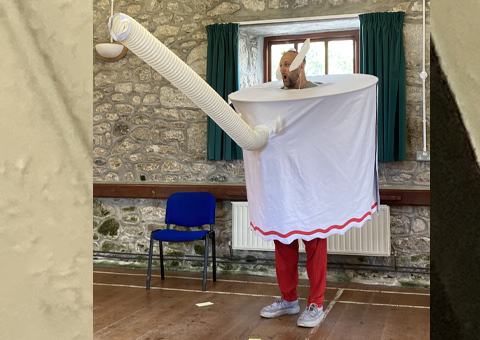
(Chroma and the cast in the sitzprobe for The Firework-Maker's Daughter)

It's the third week of opera rehearsals, and things are building to a head. The premiere is less than 10 days away and next week the whole crew moves up to Hull for the final week and the premiere in Hull Truck. Tonight is the 'sitzprobe' - the first time I'll get to hear orchestra and singers together. It does feel a little like I'm in the delivery ward and experiencing all the worries, stresses and exhaustion of an expectant father.

The first time the singers+piano ran through the whole show last week, I was left with one of those feelings familiar from instrumental rehearsals. Things are still at an early stage and so inevitably many things aren't right yet. 99% of the things that aren't right everyone involved is totally aware of, that's what these things are for. Next time they will remember to take a breath here, or move that prop over there and next time it will go infinitely more smoothly (as indeed it did only a couple of days ago). But it's inescapably quite upsetting to see your baby mangled in this way. Many young composers who arrive in their first instrumental workshops you will see in some kind of state of bewildered panic/anxiety at this point. I've learned through bitter experience it's just something you have to sit through and trust all will come right. It's funny though that you still have the feeling even if you learn to handle it a bit better.

Somehow this was all compounded for me last week by the arrival of George Benjamin's Written on Skin at the Opera House. It's a piece of mesmerising beauty, and one of those very rare entities - a new opera that actually works. It feels like the fulfillment of everything George's music has promised for so long. As my mum could tell you, I tend to be highly critical of new operas and the fact is statistically inescapable that almost all of them will be failures in one way or another. And although there were a few aspects to Written on Skin I could criticise, it felt like something so deeply thought-through and successfully navigated, so beautifully finished, I could only shout for joy 'so this is possible'! From where I stand today, I take that only as a positive, but caught up as I have been in my operatic labour ward, it made me feel very inadequate for a day or two. A good job my arrogant ego always fights its way back in the end!

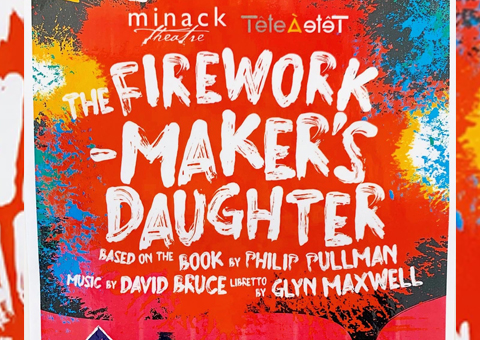
Speaking of egos, nice to fulfill one minor life ambition and get myself on a poster on the underground:


1 comment | Post comment

Concentration time

Posted on 21 February 2013


Director John Fulljames introduces The Firework Maker's Daughter


Rehearsals got under way this week. It's both a relief and a terror to have matters out of my hands now. I trust John's process completely and also trust my complete lack of certainty about what will and won't work at this stage, in terms of how the piece is staged. You formulate thoughts as you write the opera, a certain way you expect things will go, and its sometimes a bit startling when you see the director taking a different path. But I've learned over the years to watch and learn and inevitably it turns out to be the right way to do it.

I think I learned that lesson on day one of my very first opera rehearsal. The 10 minute opera I wrote for Tete a Tete back in 1999 featured a spider, a caterpillar and a dung beetle, and I'd pictured in my mind a naturalistic approach. Then designer Tim Meacock came along and showed me his sketches - the caterpillar in a sleeping bag, and the beetle in a black wheelie bin with a cut-out hole for his legs. I was quite shocked, it wasn't what I expected at all. But you stick with it because you don't have any choice, and because you know this isn't your domain of specialisation. In the end the wheelie-bin etc gave the show an added edge, a sort of Beckett-esque feeling, which definitely added a lot to the overall effect.

This production of FWMD (as we know it) is, as John says in the video above, drawing on traditions of shadow theatre from the far East, and the one impression I'm left with so far is how incredibly intricate it is going to be to get it all right. You shine a light in the wrong place and suddenly an ungainly giant hand appears in the middle of the screen. And some of the smaller effects involve a singer tracking a small light source as it moves through the air - while singing of course! Given that the performers, including the shadow puppetteers will be onstage through the entire show, I think for all of them it will be no mean feat of concentration.


0 comments | Post comment

Light the match and spark the flame!

Posted on 05 February 2013


At the weekend I was treated to a sneak preview of some of the Dick Bird's costume designs for The Firework Maker's Daughter. Here's the one for Lila which I think is absolutely delightful. I'm not sure if her jacket is made of paper, but something like it, with little burn marks all over. It looks to me like she's had quite a strict upbringing, but is also ready almost literally to catch fire, she's so full of determination to become a firework maker. It's perfect!


Rehearsals for the opera start next week. Full details of the tour over here


0 comments | Post comment

In the works

Posted on 23 January 2013


It's the new year, so time for a few New Year Announcements.

San Diego Symphony Associate Composer

I'm thrilled to have been appointed Associate Composer to the San Diego Symphony for the 2013/14 season. I'll be writing three pieces for them, including a new work for the orchetra's Carneige Hall debut in October '13, and a new violin concerto for autumn 2014 (with an amazing soloist, details of which are strictly shtum at this time unfortunately).


To kick off the association I'm delighted to be writing a chamber piece for my old partner-in-crime, mandonlist Avi Avital and we'll be premiering the new work in May this year (details here). You can read an interview Avi gave to San Diego Jewish Journal talking about our collaboration here [PDF]

New Carnegie Hall commission


Fresh from her title role in John Adam's The Gospel According to the Other Mary, the wonderful mezzo-soprano Kelley O'Connor will premiere a new work I'm writing for her as part of a US tour with soprano Jessica Rivera in October '13. The new work, provisionally titled 'That Time with You', is a further collaboration with Glyn Maxwell, though here in rather darker and more sombre mode, with poignant lyrics reflecting on death and loss. I'm deeply honoured and thankful to Carnegie Hall for co-commissioning this work with Kelley herself, and for their continued generosity and support of my career.


0 comments | Post comment

On Poetry, the body, and the earth

Posted on 10 December 2012


As work on The Firework Maker's Daughter developed, so too did my sense of artistic kinship with my librettist Glyn Maxwell. A sense of the considerable overlap in our aesthetic outlook has only been heightened by my reading of his new book On Poetry where Glyn talks incredibly engagingly about how poetry works.

The book in many ways was one of the best composition lessons I've ever had, and I may talk about more of it in a subsequent post, but the aspect I'd like to discuss here is that of the relation of the art to the act of 'being human'. For a poem to be successful, Glyn argues that it must coherently express a human presence. He's talking about something very different from the poet 'expressing his emotions', it's more to do with the way the work of art manages to conjur that palpable sense of someone being there. There are all sorts of ways this can be achieved of course - a person might be there, but in hiding; or trying to draw attention away from themselves; and of course people can have contradictory traits, but still have a coherent presence.

The heartbeat, the breath, the laugh, the cry, the step, the spoken word; these are all some of the essential starting points of music, and I do believe much of music's mysterious power can be traced to its origins in these elemental aspects of being human; just as Glyn argues that dealing with them in a poem are a crucial part of creating that sense of a coherent human presence.

I'm not sure Glyn's view of poetry translates directly to music, but I certainly think the connection between music and the physical body is very important, and one very much to the forefront of my mind when I write. Many of the 'traditional' uses of music - the lament, the celebration, the dance, the work-song - stem from physicality, and I feel sure, to adapt John Adams's phrase, that music that strays too far from that physicality is likely to atrophy.

For me, there is one other aspect which is equally important, and that is the relation to the physical world, to the earth. Where most popular music will deal exclusively with the physical - with the body - the most interesting music to me, the work whose scale and ambition I strive to match, are in touch with the connection to both the body and the earth. A Beethoven symphony does this, it is shot through with the dance, but it also looks to the horizon and roots the dance in a landscape. So too does Sibelius, perhaps his music is more connected to the body via the cry than the dance, but his human presence is inescapably connected to a windy Nordic landscape.

So although many of my rhythmic preoccupations are rooted in the physicality of popular music, I try to look beyond that for this connection with the earth. In the opening scene of Act 2 of The Firework Maker's Daughter, Lila the heroine is facing the full-force of mother nature as she attempts to reach the heart of the 'Mountain of fire'. I realise, looking at it now, that the music contains both the heart-beat of the heroine, as well as the awesome terrifying thunder of twisting lava. Physical and elemental combine. Indeed, now I think about it, perhaps one of the main ways we connect to the earth is through a sense of awe - the lone figure contrasting with the might of nature.

To people who say that classical music is irrelevant to the modern world, that pop music is the new classical music, I say, perhaps you have forgotten your connection to the earth. Think no further than the ubiquitous role of amplification in pop music - even so-called 'unplugged' sessions. It's less a side-effect than a deliberate intention of amplification to hermitically seal the listener off from their connection to the earth. A modern, man-made bubble, every bit as counter-natural as the air-conditioning and double-glazing. (This dislike of amplification by the way, was part of the twisted logic behind my Steampunk piece).

Now I can see that what I am striving to achieve is to give the listener the sense of themselves and of the players sitting naked on this beautiful rock we call home, to unmask the reality that lies underneath the layers of clothing, the comfortable seats and the insulated building. Because music deals with these fundamentals, it's pre-historic, it's pre-language, it speaks to that part of us which we spend most of our days avoiding - the part Glyn describes as "ourselves before language, hiding or hunting on that lonely bright savannah".


0 comments | Post comment

Have all the good melodies already been used up?

Posted on 21 October 2012


For some reason I feel the urge today to answer this perennial question: Have all the good melodies already been used up? To answer it I will have to delve into a little very light mathematics and also reveal a potentially billion-dollar idea I've had for many years.

Start by comparing a melody to the moves in a game of chess. One of the reasons chess is so popular is that after only a very few moves, the possibilities of what could have happened have become so vast that they allow for a near infinite amount of combinations.

Let's take the most basic aspect of a melody - whether each note goes up, down, or stays the same compared with its predecessor. Comparing this one aspect after just twelve notes you've already reached over half a million possibilities. This was the thinking behind a great book I discovered in my school library many years ago, the Dictionary of Musical Themes


This book lists over 10,000 popular melodies using a code U for up D for down and S for stays the same. All you need to do is think of this melody contour for your piece (eg *SUSUSDDSDSDSD for Twinkle Twinkle Little Star) and the chances are you will find it in the book.

Now the reality of melodies is you actually have 12 possible notes (more if you count octaves of course though I can't think off hand of a famous melody than includes a span greater than an octave - please post in the comments if you think of one). With 12 options, it only takes 6 notes to get to 2,985,984 possibilites.

But we've forgotten something - rhythm. It's hard to quantify exactly how many different rhythms you could have for each note of your melody. Even if we stick to 'rational' rhythms it's a bare minimum of 16 (anything from a semiquaver through to a semibreve). If we just stick to that we have 16*12 possibilities for one note. That means just three little notes have a staggering 7,077,888 possibilities. And a 6 note melody (which is still pretty short) could have 50,096,498,540,544 possibilities!

But that's not even the end of it. Not counting all the other rhythmic possibilities we could add, of which simple triplets would be by far the most common; not counting all the ways notes can be ornamented or embellished - of which there are countless; we haven't even thought about harmony. And harmony is one of the great hidden secrets of melody. Many of your favourite tunes will be your favourite not just because of the notes themselves, but because of the way the harmony moves beneath them, giving some notes a satisfying 'soft-landing' or a deliciously unexpected sense of arrival. You only have to think of the famous One Note Samba to realise how important harmony is to melody.

So lets ultra-conservately add 8 more harmony options per note which gives us 1536 options per note. Our 6 note melody now yields 13,132,496,513,412,366,336 options. Which is probably enough to make even most chess players slightly daunted.

Now to that billion-pound idea.

If we go back the Dictionary of Musical Themes, I realised that if you were to add in a similar component for the rhythmic contour of a melody - three options, shorter, longer or stays the same, you could combine this with the Up-Down-Same pitch contour to come up with a 'code' for each melody where each note would be one of 3x3=9 options. We would start by encoding every melody into a string of characters (they could just be numbers 1-9) based on this. Then all you need is the technology to recognise whether someone is whistling/singing a note longer or shorter, higher or lower accurately, and within only a very few notes you could accurately know which song they meant. If you could create an iphone app that did this well I promise you you wouldn't be that far off the billion pound mark.

Being an entrepreneurial type I did actually try to set something like this up a few years ago, in a website I called tunespotting.org There are three very difficult problems to overcome. One is to accurately convert all the melodies in the world into this code. The second is to accurately convert someone's tone-deaf and inaccurate hum/whistle into the correct contour. And the third is to match the two resulting 'strings'. Given that there are some amazing 'loose-match' string searching programs out there, the third of these already exists; and also given things like the amazing Melodyne program which does a pretty good job of separating out indivual notes from an audio file, I really believe the technology already exists to make this a reality and for somebody to make a lot of money from it. It would take a lot of time and effort to get it working smoothly however, and, much to my dad's chagrin, I seem to prefer spending my time exploring just some of those 13,132,496,513,412,366,336 possibilties.


0 comments | Post comment

Foot in the door

Posted on 12 October 2012


It's nice when pieces start to take on a life of their own. I recently received an email from a member of Hartt Music School's Foot in the Door ensemble, saying he'd enjoyed Steampunk at a recent performance by Hudson Valley Chamber Winds and was even happier that his own group had decided to program the piece in their concert this October 17th. I hadn't even heard about the Hudson Valley performance, so this was a double delight. Having repeat performances through word of mouth alone is such a thrill and an honour - you know the performance is happening for no other reason than because the group wants it to happen! Have a great concert guys!

Update

It turns out the Atlantic Chamber Ensemble are also giving another performance of Steampunk this Saturday 20th in Richmond VA. Always a group to add a splash of fun and colour to a concert, the election-themed concert is billed as 'Bruce vs Beethoven' and the audience gets to vote! I'm not sure I fancy my chances there!


ACE are also performing Gumboots next year in collaboration with Amaranth Contemporary Dance which is the first time this dance-inspired piece will have been actually accompany dance.


0 comments | Post comment

Climbing Mount Merapi

Posted on 21 August 2012


Work on my new opera The Firework Maker's Daughter is - from my side at least - very nearly complete. We will have a short orchestral read-through with musicians from Opera North in October, which is very helpful - but other than that, I will do my best not to spend hours dwelling and sweating over every last detail AGAIN. Work now gets handed over to everyone else - director John Fulljames and designer Dick Bird (who designed The Opera Group's Enchanted Pig among many others) are pulling ideas together and have been working with Steve Tiplady and Sally Todd of Indefinite Articles to dream up the concept for the show - the way of presenting it. There will definitely be some shadows, quite a lot of shadows!

In the new year the singers will begin rehearsing and the tour will start in March. Details of the tour are finally being knocked into place. It's a pretty big one, which includes Watford Palace Theatre and some of Opera North's regular touring venues. From 3-13 April it will come to the Linbury Studio Theatre at the Royal Opera House, Covent Garden; and from 3-12 May it will be in New York at the New Victory Theatre on 42nd street, just round the corner from Time Square. Keep up with the latest tour info on The Opera Group's page here

One of the things I'm most delighted about is that the fact that two of my favourite ensembles will be performing - Chroma in the UK, and Metropolis Ensemble in the US. Working with friends takes a lot of the pressure out of the situation which is good. Because there is a certain pressure in all this. Put it this way - you spend about three years working on something; then, although there have been workshops and there will be rehearsals, the first time you can really begin to judge how successful it's all been is at the dress rehearsal- literally a day or two before the premiere - that's the first time the show finally gets run with all the musicians and all the design in place. And by then of course it will be far too late to do anything about it!

I find I can't help comparing myself to Lila, the heroine of the opera. By which I don't mean to imply that I'm a head-strong young girl with pyrotechnic tendencies. But writing an opera can certainly be compared to the exhausting and near-impossible challenge Lila faces when she sets out to climb Mount Merapi to get her hands on the elusive 'Royal Sulphur', that secret ingredient all true Firework Makers must have. What's so touching in the story is that when Lila finally reaches the summit and meets the dreaded Fire-Fiend he just laughs at her and she leaves empty-handed, feeling the whole journey has been for nothing. This, to be quite frank, is how it often feels being an artist. I've climbed my mountain and faced my Fire-Fiend but for now all I have to show for those three years work is 500 sheets of paper with black dots on them. It's a curiously laughable state of affairs.


0 comments | Post comment

New Sounds - Prince Zal and the Simorgh

Posted on 12 June 2012


Here's an extract which the LPO have kindly given me permission to post of my recent piece for narrator and orchestra, Prince Zal and the Simorgh. This is the final four minutes of the piece.

In the story, written and narrated by Sally Pomme Clayton - based on a story from the old Persian epic poem The Shahnameh - King Sam abandons his white-haired son on a deserted mountain. but it turns out the mountain is home to the magical bird, the Simorgh, who looks after the baby Prince Zal and raises him. Sixteen years later, King Sam's life has been lonely and miserable, and he sees the error of his ways. He comes to the mountain to pray for his sons forgiveness, and is astonished to see a white -haired boy jumping across the rocks. Zal tells the King the mountain is his home and he can't leave his mother - but then the Simorgh appears - and that's where we pick up the story:


0 comments | Post comment

Boots, Forgotten and International

Posted on 08 June 2012


The second batch of players enrolled in Carnegie Hall's Academy program, and their performing arm Ensemble ACJW are giving the final performance of their tenure this Sunday at Le Poisson Rouge in NYC, and I'm honoured that they asked me to be part of it. They requested a 2 minute piece, and up to my neck in opera as I am, I was concerned even that would be a struggle. Then I remembered the lost movement of Gumboots which I'd reworked for Todd Palmer for clarinet and piano (it hasn't yet been performed after Todd's pianist fell ill for the premiere). I suggested to the ACJW players that it would make a fun short piece to rework for their entire 20+ players (including two pianos!). The concert also features an enticing mish-mash of pieces by Mahler, Lennon and McCartney, Faure, and Taraf de Haidouks! Please come down and support these great players! More details on the Carnegie Hall website and tickets via L.P.R.

Later in July there are two international performances of
Gumboots to look forward to - Spain's foremost contemporary clarinettist José Luis Estellés performs it Granada on 17th June, and on 23rd, Sarah Beaty and colleagues from the newly formed The Declassified (all ex-ACJW players) perform, excitingly in Iceland - how I wish I could attend both these performances.

**

I should also draw attention to the Spitalfields & London premiere of Fire on 23rd June, and earlier that day I shall be honoured to be sharing a Meet the Composer event/talk with Howard Skempton.


0 comments | Post comment


Archive


2013: Jan Feb Mar Apr May Jun Jul Aug Sep Oct Nov Dec 
2012: Jan Feb Mar Apr May Jun Jul Aug Sep Oct Nov Dec 
2011: Jan Feb Mar Apr May Jun Jul Aug Sep Oct Nov Dec 
2010: Jan Feb Mar Apr May Jun Jul Aug Sep Oct Nov Dec 
2009: Jan Feb Mar Apr May Jun Jul Aug Sep Oct Nov Dec 
2008: Jan Feb Mar Apr May Jun Jul Aug Sep Oct Nov Dec 
2007: Jan Feb Mar Apr May Jun Jul Aug Sep Oct Nov Dec 
2006: Jan Feb Mar Apr May Jun Jul Aug Sep Oct Nov Dec 



All works are available through billholabmusic.com.

Perusal Scores, Sales
Rental Information
Order Music Online


Bill Holab Music,
377 Sterling Place, No. 4, Brooklyn, NY 11238
phone: 718-499-3946 | fax: 718-228-8085 |
email:


       Latest CD release

THE MYRIAD TRIO: THE EYE OF NIGHT

The Myriad Trio launches their debut disc, featuring classic work for flute, viola, and harp. The last piece on the CD is the source of inspiration for the disc and the work that anchors the album: The Eye of Night. Commissioned and premiered by The Myriad Trio in 2010, The Eye of Night, written by the British-American composer David Bruce, highlights the very special qualities that make this instrumental combination distinctive and this unique ensemble extraordinary.

Buy now on amazon.com
Buy now on itunes

Recent blog posts

  • Giving birth
  • Concentration time
  • Light the match and spark the flame!
  • In the works
  • On Poetry, the body, and the earth


  • Most popular blog posts

  • Beginners Lessons in Tabla playing
  • Indian melodies, Indian ornaments
  • Building a Cajon
  • My Lagerphone is built
  • St Albans Organ Museum
  • © 2013 David Bruce